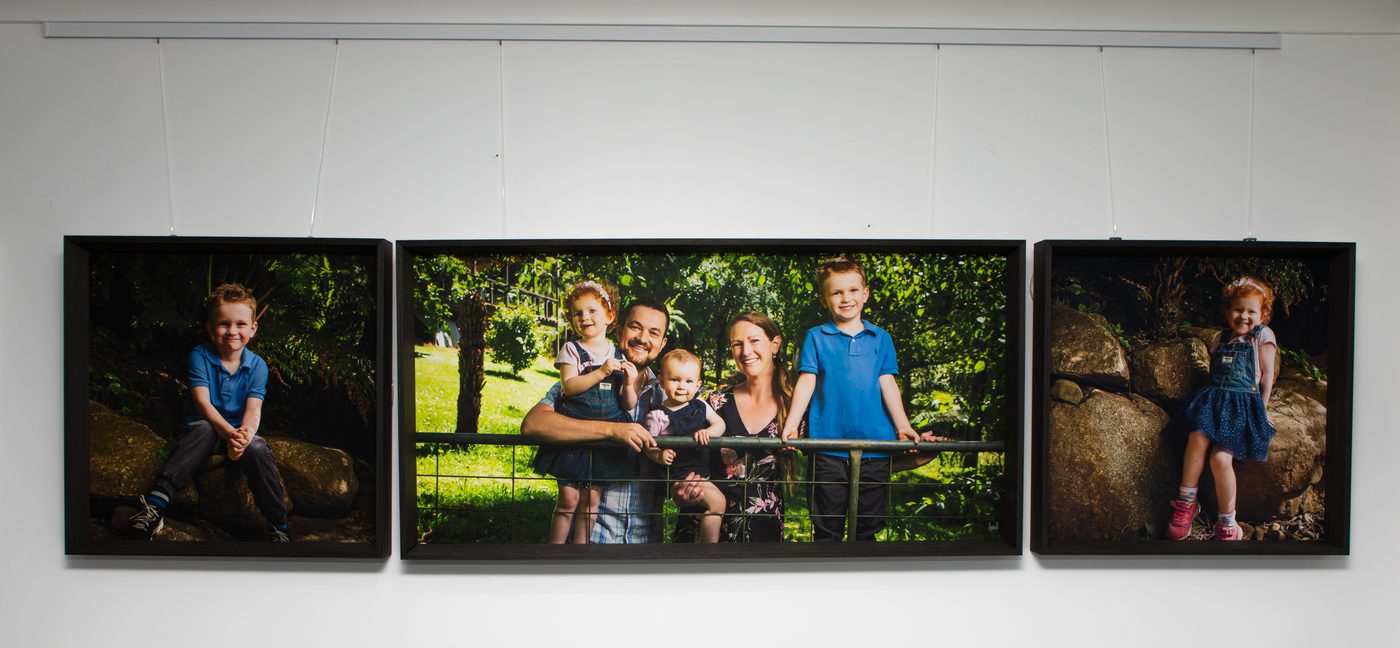
Most loungerooms have one wall that already wants a portrait on it, usually above the sofa or the mantel, and the two things that decide whether it works are size and height. Get the scale right against the furniture below it, hang it so the centre sits near eye height rather than sofa height, and choose early whether you want one statement piece or a considered collection. Everything else, frame style, wrapped canvas or Story Board, is a finishing decision once those two are settled.
The sofa wall is your biggest opportunity
In most homes, the loungeroom is where family life actually happens, and the sofa wall is the one everyone faces while they're sitting still long enough to look at something. It's why this wall carries more weight than almost anywhere else in the house. A portrait here isn't decoration in the background, it's the thing you glance at while the kettle boils in the next room, or the thing a guest comments on before they've even sat down.
That's also why it's worth treating differently to a hallway display, where people are moving past rather than settling in. The loungeroom rewards a piece with enough presence to hold its own from across the room, not a series of small prints meant for close inspection.
Scale: the size that actually works
The single most common mistake in a loungeroom is a portrait that's too small for the wall it's on. A piece that would feel generous above a hallway console can look lost above a three-seat sofa with a full wall of empty space either side of it.
A few working rules:
- Aim for the piece, or the combined width of a collection, to sit at roughly two thirds the width of the sofa below it.
- Leave breathing room either side, at least the width of your hand from the edge of the sofa arm to the edge of the frame.
- If you're choosing between two sizes and you're not sure, go up rather than down. An oversized piece reads as intentional. An undersized one reads as leftover.
This is where a premium canvas earns its place in a loungeroom especially, because the larger formats, from around 20x30" up to the largest wrapped sizes, are built for exactly this kind of wall. A single 30x40" canvas above a sofa does more for a room than three smaller prints trying to fill the same space.
Eye height, not sofa height
The habit that trips people up is displaying to the sofa rather than to the room. If you display a portrait so its centre sits at eye height for someone seated on the sofa, it ends up too low for everyone standing in the room, which is most of the time a loungeroom is actually being used, walking through, standing to talk, arriving with a cup of tea.
The fix is simple. Display so the centre of the piece, or the visual centre of a collection, sits somewhere between 145 and 155 centimetres off the floor, which is close to standing eye height for most adults. Above a sofa specifically, that usually lands the bottom edge 15 to 20 centimetres above the sofa back. It looks slightly higher than instinct suggests, and it's almost always right.
The mantel: a different kind of display
Not every loungeroom has a sofa wall to work with, and a mantel offers a different kind of opportunity. Rather than one fixed piece displayed and forgotten, a mantel display can be leaned rather than mounted, layered with a small stack of objects, and changed through the year without a single new nail hole.
A framed print in one of the smaller sizes, or one piece from a Designer Portfolio set, works well here. It sits lower than a wall-mounted piece would, closer to the room's everyday sightlines, which makes the mantel a good spot for a portrait you want to actually live with rather than simply display. Think of it less as a fixed installation and more as a window on your favourite wall, one you can shift and restyle as the room changes around it.
One statement piece, or a considered collection
This is the decision worth making before you choose a size, because it changes everything downstream. A single statement piece, a large wrapped canvas or a Framed Story Board, gives the room one clear focal point and suits a family who wants the choosing done once, well, and left alone.
A collection does something different. Multiple pieces, sized and framed to work together, let you tell more of the story across one wall, several moments rather than one, and give a bigger wall the presence a single piece sometimes can't reach alone. Our Wall Art Collections are built for exactly this, sized and matched as a set rather than assembled piece by piece.
If you're drawn to the idea of several portraits working together rather than one, it's worth reading through our guide to designing a gallery wall before you commit to a layout, since the spacing and grouping principles there apply just as much to a loungeroom wall as anywhere else in the house. And if the loungeroom is only one of several rooms you're planning for, our guide to displaying portraits in the bedroom covers the quieter, more personal end of the same decision.
Whichever way you land, the choice gets made properly at the design appointment, in front of the actual wall dimensions and the actual images, rather than guessed at from a screen beforehand.
Every portrait begins with a conversation at the Belgrave gallery.