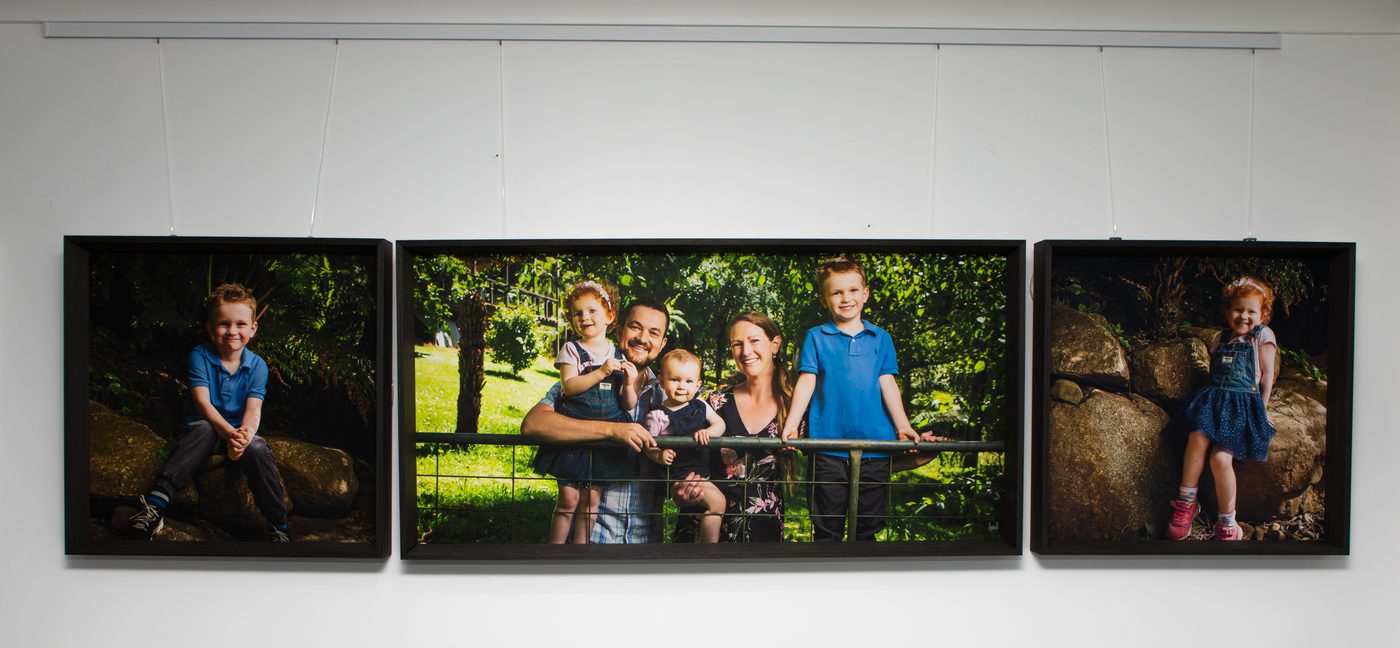
A hallway rewards a sequence rather than one big statement piece. It's a corridor you walk through daily, seen up close for a second or two at a time, so a run of smaller, connected portraits along the wall works harder than a single large canvas would in that spot. Framed Story Boards and Designer Portfolio Prints were built for exactly this kind of display, and a hallway is where most families end up putting them.
Why the hallway is different to the loungeroom
The loungeroom is where you sit and look, often from a few metres away, which is why it usually carries the one large piece the room is built around. The hallway is the opposite. You pass through it, you don't linger in front of it, and the viewing distance is close, often less than a metre. A single oversized canvas can feel like it's looming over you at that range. A sequence of smaller pieces, spaced along the wall at eye level, gives you something new to notice each time you walk past instead of one image you stop registering after the first week. If you haven't settled the loungeroom piece yet, our guide to displaying portraits in the loungeroom covers how that decision is made separately from this one.
Framed story boards, built for corridors
A Framed Story Board is a set of images, usually three to five, mounted together as one connected piece rather than several separate frames. Four designs are available, Windsor, Riverrun, Harrenhall and Iron Throne, each with its own layout and framing detail. They work in a hallway because they read as a single considered display rather than a scattered collection of mismatched frames, while still giving you the sequence a corridor calls for. We walk through exactly how each design is put together in our guide to framed story boards, including how the images within one board are chosen to sit together.
Designer Portfolio Prints, one after another
Where a story board is one fixed piece, Designer Portfolio Prints let you build a looser run along the wall over time. Each print is an 8x12" portrait set in an 11x14" mat, from $250, and they're designed to be added to individually rather than committed to as a set all at once. A family might start with three prints from one session and add two more from the next, and the hallway is the natural place for that kind of display, since the wall simply extends as the collection grows. It suits families who want the option to keep adding sessions over the years without redesigning the whole wall each time.
Sizing and spacing for a corridor
Most hallways are narrower than the rooms either side of them, which changes what fits well.
- Keep individual pieces modest. Anything from a Designer Portfolio Print up to a mid-sized canvas, roughly 11x14" to 16x20", suits the scale of most corridors better than the larger end of the canvas range.
- Display at eye level, not gallery height. In a hallway you're rarely standing back to view the wall as a whole, so the centre line should sit where your eye naturally falls as you walk, generally lower than the standard 145cm gallery centre used in wider rooms.
- Leave breathing room between pieces. Even spacing along the run matters more in a hallway than in an open room, since the eye travels along the wall in one direction rather than scanning it from a fixed spot.
- Let the wall's proportions decide the shape of the run. A long, narrow hallway suits a single horizontal line of pieces; a hallway with a turn or a wider section can carry a small cluster at that point.
Round metal prints, 12" or 20", are worth considering for a hallway as well. Their shape breaks up a run of rectangular frames and reads well at close range, which suits a space you view up close by nature.
Planning the wall at your design appointment
None of this needs to be decided on the spot. At the design appointment that follows your session, you'll see the full range of sizes and framing options against your actual images, and that's the right time to work out what suits your hallway specifically, its length, its light, the width of the wall. If you're weighing up a hallway sequence against a larger single-room display, our guide to designing a gallery wall is worth reading alongside this one, since the same session's images can often be split between the two, a stronger portrait or two for the loungeroom and the rest built into the hallway's story.
The hallway is the one wall in the house you see every single day. It's worth treating as a small gallery rather than an afterthought.
Prices for every product mentioned here, along with the full range of sizes and framing, are shown openly at your consultation at the Belgrave gallery. There's no pressure to decide anything before then, and most families find the shape of their wall becomes obvious once they're standing in front of the actual images.
Every portrait begins with a conversation at the Belgrave gallery.