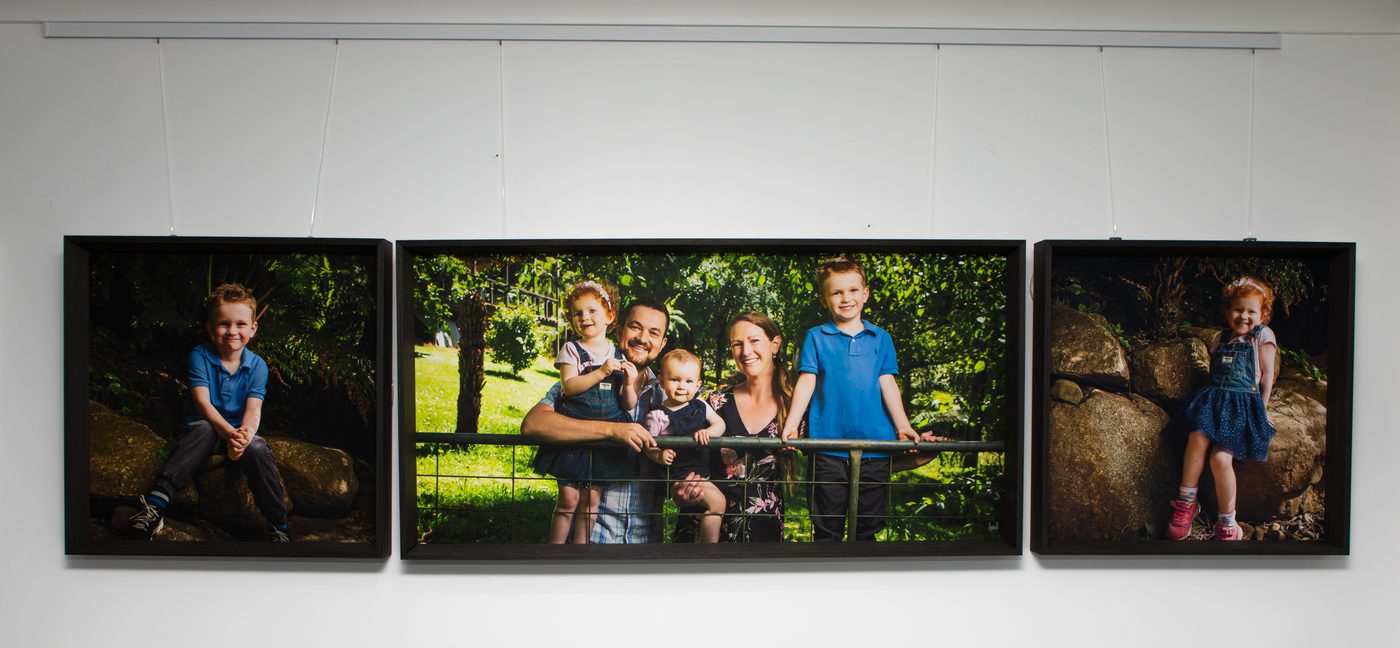
Wrapped canvas has the portrait printed around the edges of a deep timber frame with no border, so the piece floats on the wall on its own. Framed canvas is the same premium canvas print set inside a discrete timber frame that runs around the edge. Both come from the same range, 11x14" to 36x55", from $450, and the decision usually comes down to how you want the piece to sit against your walls rather than one finish being better than the other.
What's actually different between the two
With a wrapped canvas, the image continues around the sides of the timber frame it's stretched over, so there's no visible edge or border when you step back from the wall. It reads as a single, continuous piece, more like a painting than a photograph in a frame. A framed canvas has that same stretched canvas, but it sits inside an additional timber frame that wraps around the outside, giving the piece a defined edge. Neither uses glass. The canvas surface itself has a texture to it, and part of what a frame does is protect that edge rather than cover the surface.
When wrapped canvas tends to suit the room
If your home leans modern, minimal, or you want the artwork to feel like it belongs to the wall rather than sitting on top of it, wrapped canvas is usually the better read. It has no hard edge to compete with the rest of the room, so it works well in open-plan spaces, on feature walls, and anywhere you're building a gallery arrangement of two or three portraits and want them to feel unified rather than boxed. It also suits corridors and hallways, where you view the piece walking past at an angle rather than standing square in front of it, because there's no frame lip to catch the light or draw your eye away from the portrait itself.
When a frame earns its place
A framed canvas gives the piece a visual boundary, which matters more in some rooms than others. In a more traditional or heritage home, or a loungeroom with existing timber furniture, skirting, or trim, a frame ties the artwork into that language rather than looking like it's from a different era. A frame also does real work when a single piece is the focal point of a wall on its own, above a mantelpiece or at the top of a staircase, because the edge gives the eye somewhere to land before it moves into the portrait. If you're after that sense of a considered, finished statement piece rather than something loose and floating, framed is usually the answer.
What the frame itself is made from
The timber frame on a wrapped canvas is a deep stretcher bar, built to hold the canvas taut with enough depth that the piece sits proud of the wall, casting a slight shadow of its own. On a framed canvas, that same stretcher sits inside a second, visible timber moulding, which is where the choice of finish, a lighter oak tone against a darker walnut, for instance, starts to matter as much as wrapped versus framed. Both are built to hold their shape over years on the wall rather than to be swapped in and out, so it's worth thinking about the room you're in now and the one you expect to still be living in.
Choosing for the room, not just the wall
The honest starting point isn't the canvas at all, it's the room. We talk through where the piece is actually going to live: what's opposite it, what light hits it through the day, what furniture and colours are already in that space. For more on how that plays out room by room, our guide to displaying portraits in the loungeroom walks through sightlines, furniture height, and where a piece needs a frame versus where it doesn't.
Size and finish work together too. A large wrapped canvas over a sofa can carry a room on its own, while the same size framed might need a slightly smaller neighbouring piece either side to balance it. If you're still deciding on dimensions, our guide to choosing wall art size covers how to measure your wall and match the piece to the space rather than guessing.
The print underneath the finish
Whichever finish you land on, what's actually printed matters just as much. Every canvas we produce is archival printed and hand finished, which affects how the colour and detail hold up over years on the wall, not just how the piece looks on day one. If you want the detail on how that process works and why it's worth asking about wherever you have portraits printed, we've written it up separately in our guide to archival printing.
Deciding together at the design appointment
You don't need to land on wrapped or framed before you come in. At the viewing and design appointment, once you've chosen your favourite images from the session, we work through the actual wall it's going on, in your home if that's useful context, and land on the finish that suits the piece and the room together. Premium canvas across both finishes runs from $450 and spans 11x14" up to 36x55", so the same decision applies whether it's a single statement piece or part of a larger wall art collection.
What tends to settle it, more than any rule about modern versus traditional homes, is what's already on that wall and what's next to it. A frame next to other framed art in the house will feel deliberate. A wrapped canvas next to bare, clean walls will feel like it belongs there from the start. Bring a photo of the wall to your consultation if you have one, it makes this part of the conversation far easier than describing it from memory.
Every portrait begins with a conversation at the Belgrave gallery.