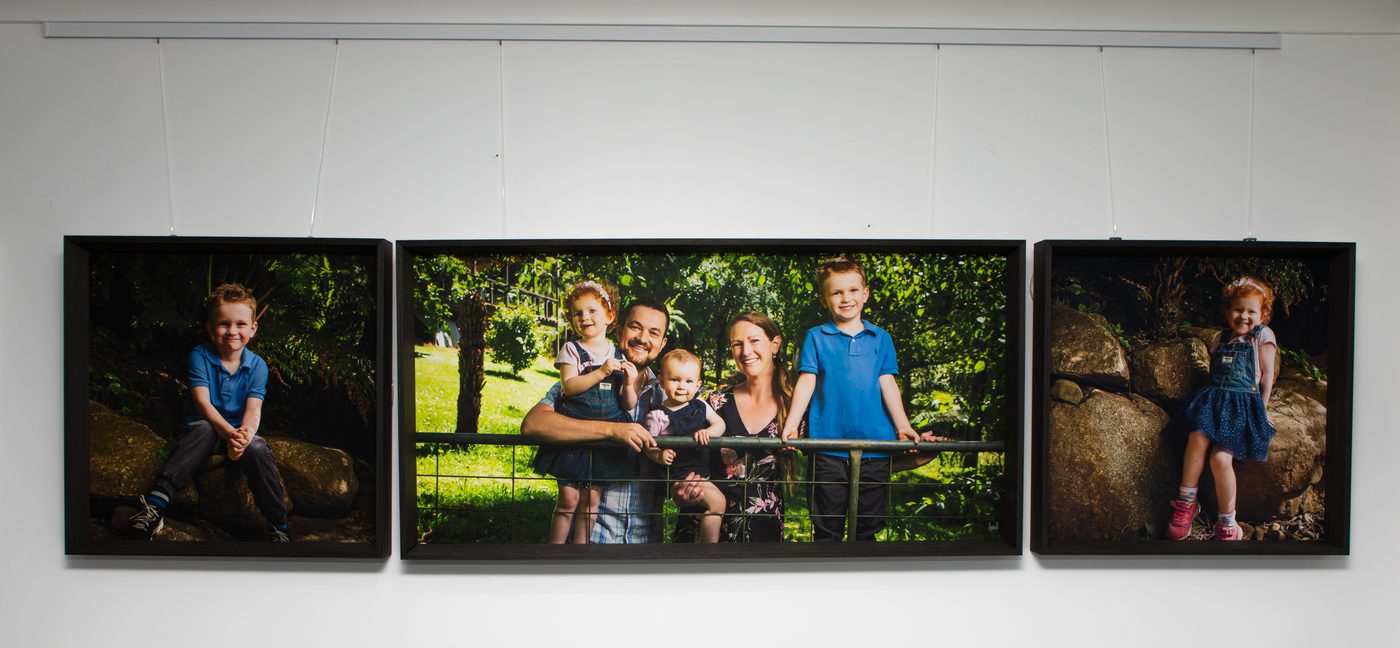
Archival printing is a print, mount and finish process chosen for one outcome: longevity. Instead of the fast consumer inks and papers used for everyday snapshots, an archival print uses pigments, substrates and finishing methods tested to resist fading, yellowing and physical damage for decades rather than years. For a family portrait, that's not a technical footnote, it's the whole point. The portrait only matters if it's still there to look at, and still looking the way it did on the day you chose it, long after the session itself is a memory.
Why this matters more than people expect
Most people have never thought about what happens to a printed photo over time, because most of the photos we take never get printed at all. The ones that do, a supermarket print, a mug shop canvas from a weekend sale, are made with the cheapest process available. Within a handful of years in normal room light, the blacks lift to grey, skin tones shift warm or pink, and the surface starts to crack or lift at the corners. None of that is a manufacturing fault. It's what happens when a print isn't built to last, and it happens quietly, a little more each year, until one day you notice the piece on the wall doesn't look like the moment you remember.
A family portrait is different from a holiday snap in one important way: you're choosing it to represent your family at a point in time, and you want that representation to hold up. Your children's faces, the light on the day, the way you're standing together, all of it should still look true when your children are grown and showing the piece to their own kids. That's the standard we hold ourselves to, and it's also why portraits are priced as artwork rather than as ordinary photography.
What makes a print archival
Three things have to line up.
- The print process itself. The pigments and the method that lays them down need to be stable under UV exposure and ordinary indoor light, not just under gallery lighting for a week.
- The substrate. Whether it's canvas or fine art paper, the material it's printed on needs to hold its structure and colour over time rather than yellow or become brittle.
- The finishing. Hand-finishing, mounting and sealing all affect how the piece behaves in a real home, including humidity, sunlight through a window, and simple handling over years.
None of these on their own make a print archival. It's the combination, chosen deliberately, that does. We don't chase a particular paper or ink brand name for its own sake, and we're not interested in whatever's cheapest to source that week. We choose what actually performs to archival standards, and we hand-finish every piece ourselves so nothing about that process is rushed.
How this shows up in your piece
At your viewing and design appointment, you choose the images and the products, and from that point your artwork is artisan printed and hand-finished specifically for you. That's not an automated print run pulled off a shelf. Every piece, whether it's a single canvas or a full Wall Art Collection, goes through the same archival process, which is part of why the finished piece looks and feels different from a print you'd order online.
It also means the piece is built to be displayed, not just stored. A portrait that's genuinely archival can sit above the fireplace or along the hallway in direct daylight for years without you worrying about it fading behind everyone's back. That's a meaningfully different relationship with the piece than one where you quietly know it's degrading and simply haven't noticed yet.
The point of an archival print isn't the day it's finished. It's every ordinary day after that, for as long as your family lives with it on the wall.
Framing built for the piece to outlast you
Archival standards don't stop at the print. How a piece is wrapped or framed matters just as much, because the frame or wrap is what protects the print from light, dust and handling for the rest of its life. That's part of why we walk families through wrapped versus framed canvas at the design appointment rather than treating it as an afterthought, and why the framing itself is built to the same durability standard as the print inside it. A piece that's meant to be handed down needs framing that's meant to be handed down too.
What "ready within three weeks" actually covers
Because the printing and finishing are done properly rather than automated, your artwork takes time. Once your design appointment is complete and you've chosen your images and products, your pieces are artisan printed, hand-finished and ready for you to collect within three weeks. There's no delivery or installation service, so that collection window is worth planning around, particularly if you're timing the piece to arrive before a birthday or a family gathering. If you want a clearer sense of why the physical print matters as much as the image itself, this guide on printed portraits covers the other half of that thinking.
The short version
Archival printing is slower, more deliberate and more expensive than a standard photo print, and every part of that process is chosen for one reason: so the portrait on your wall still looks the way it should in twenty, thirty or fifty years. It's not a marketing term. It's the difference between a photo that fades in a decade and artwork your family keeps.
Every portrait begins with a conversation at the Belgrave gallery.