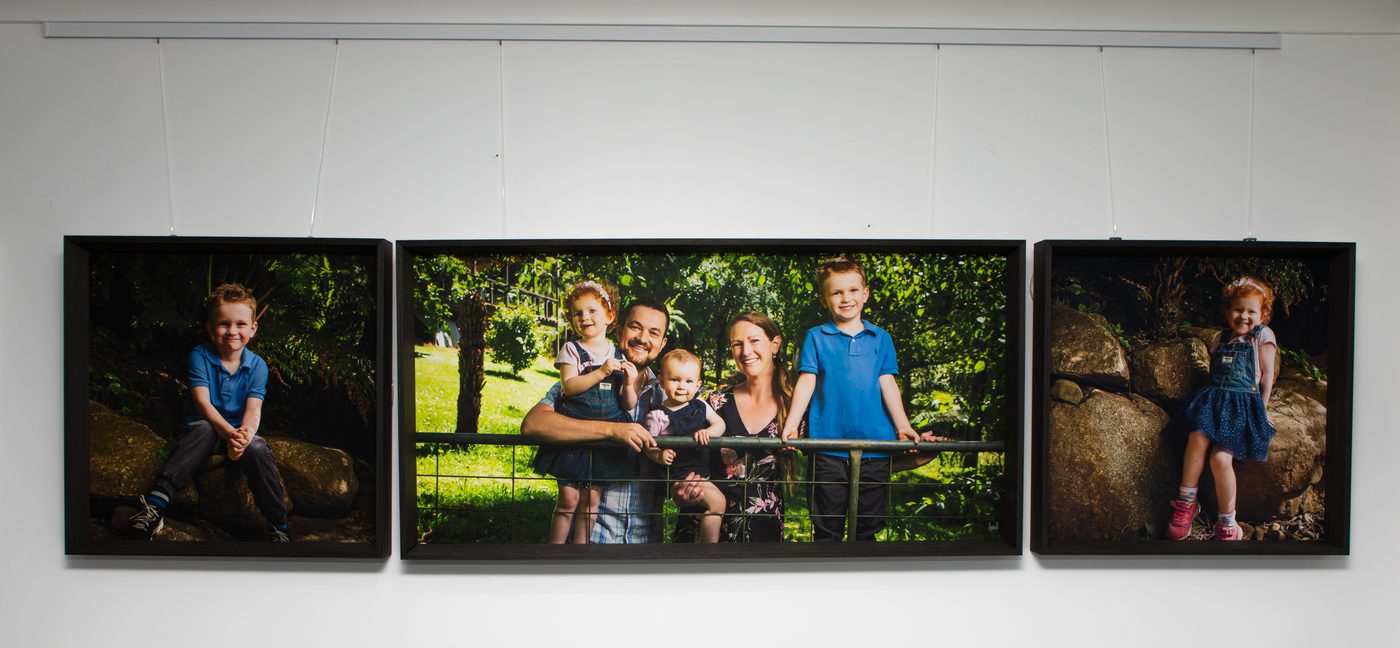
Canvas wall art for a family portrait typically starts at 11x14 inches for a single accent piece and runs up to a large 36x55 for a wall that needs a proper anchor. There is no universal right answer. The size that works depends on how much wall you actually have, what furniture sits beneath it, and how far away you usually stand or sit when you look at it. That is why sizing is never something we hand you a chart for and leave you to guess. We work it out with you.
Start with the wall, not the picture
It is tempting to pick a size the way you would pick a print size for a photo album, based on what looks good on a screen. A wall behaves differently. The same portrait that feels intimate at 11x14 inches on a hallway shelf can read as almost invisible once it is mounted on a large, open expanse of wall. Before you think in inches, think about the wall itself: its width, its height, what is near it, and what your eye meets first when you walk into the room. A tall stairwell wall and a low hallway wall want quite different treatments, even if the portrait on them is identical.
Let your furniture set the scale
One of the simplest ways to judge size is to look at what sits below or beside the space, rather than the wall in isolation. A single canvas above a sofa, a bed head, or a console table should feel proportionate to that piece of furniture, not perched on top of it like an afterthought and not so large it overwhelms the room. If you are working with more than one piece, this is also where a gallery wall comes into its own, since several smaller or mid-sized pieces arranged together can command the same wall as one large canvas, with more flexibility around awkward corners, doorframes and light switches.
Think about how far away you'll actually be
Viewing distance matters more than most people expect. A piece at the end of a long hallway or across a stairwell landing, somewhere you pass at a distance rather than stand close to, can carry far more scale than a piece in a reading nook or beside a favourite chair, where you sit close and take in the detail. If you are deciding between wall art for a loungeroom, where people gather and sit back from the wall, the same logic applies as we cover in displaying portraits in the loungeroom, just scaled to your own room's proportions. As a rule of thumb, the further back you naturally stand from a wall, the more size that wall can take without feeling like a poster.
The mistake almost everyone makes
Given a free choice, most people size down. It feels like the safer, more modest option, and a piece in your hands at the design appointment always looks larger than it will once it is on an actual wall, surrounded by ceiling height, furniture and empty space. The result, more often than not, is a portrait that disappears into the wall rather than anchoring it. If anything, when you are torn between two sizes, the larger one is usually the better call, particularly for a feature wall, a stairwell, or any space with genuine height and width to fill.
The size that feels almost too big in the studio is usually the size that looks right once it's actually on your wall.
Wrapped or framed also changes how a size reads
Size is not the only decision that shapes how a piece sits on your wall. Whether it is wrapped or framed changes the visual weight it carries even at the same dimensions, a framed piece tends to read as slightly larger and more formal, while a wrapped canvas sits closer to the wall and feels more contemporary. If you are still deciding between the two, it is worth reading wrapped versus framed canvas alongside this guide, since the two decisions, size and finish, are best made together rather than one after the other.
This is why we design it properly, not off a price list
This is also why sizing is not something we ask you to decide from a brochure before you have even seen your portraits. At your design appointment, we work from photos of your actual wall, the one the piece is going onto, and place your favourite images against it so you can see, roughly, how a given size will sit in the room before you commit to it. For a multi-piece Wall Art Collection, that same wall photo lets us plan spacing and proportion across several pieces at once, rather than guessing how they will sit relative to each other once they are all on the wall. It takes the guesswork out of the one part of the process that is genuinely hard to picture from a screen.
A short way to think about it
If you take nothing else from this, hold onto three questions. How much wall do you actually have, uninterrupted by switches, frames or furniture. What sits beneath or beside it, and how large is that. And how far back do you usually stand when you look at that spot. Answer those three honestly and you are most of the way to the right size, before we even sit down together with your portraits and a photo of your wall.
Every portrait begins with a conversation at the Belgrave gallery.