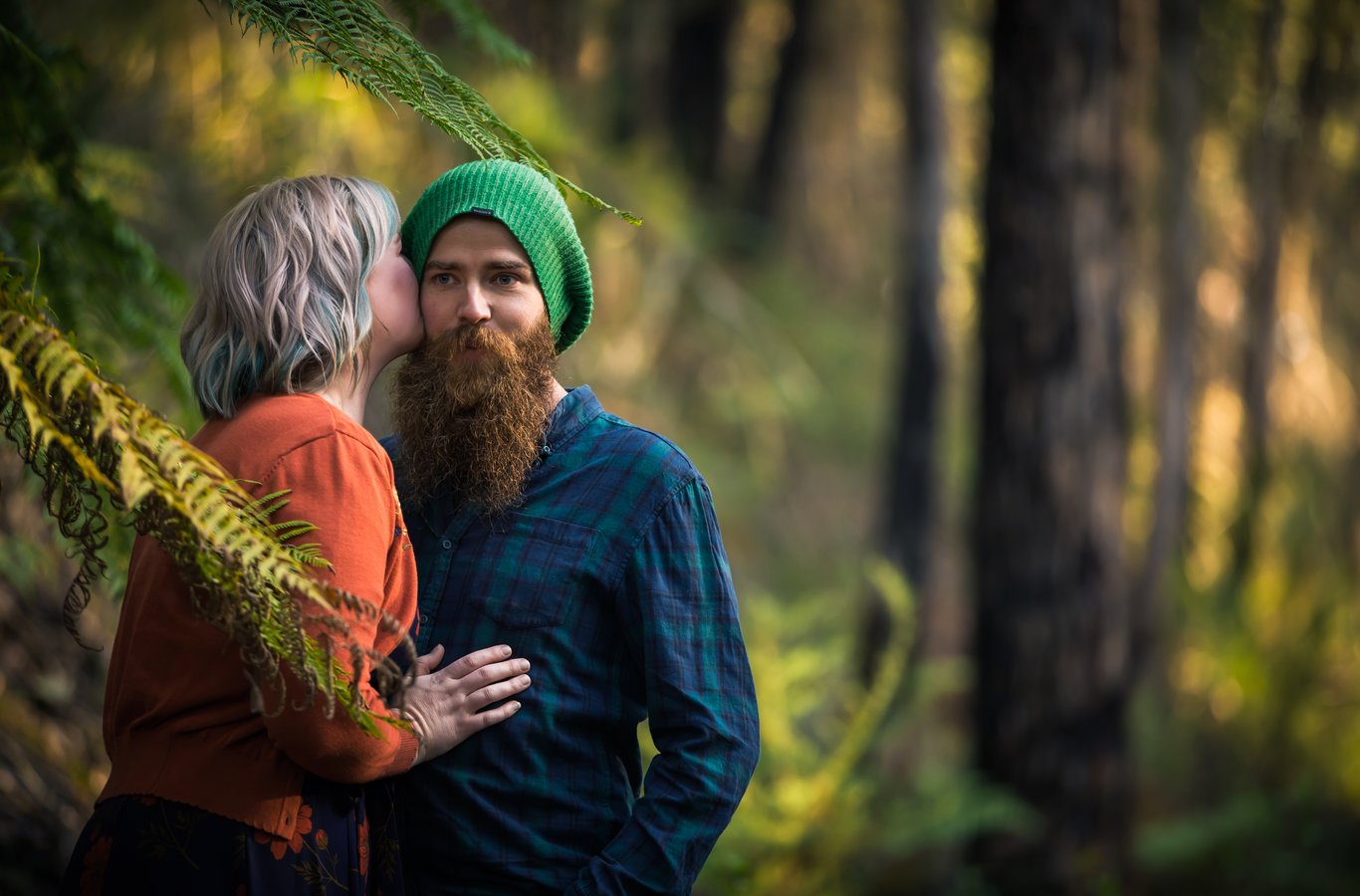
A good family portrait comes from what happens between the poses, not the poses themselves. It comes from a photographer who directs rather than arranges, who knows a family well enough to recognise a real moment the instant it appears, and who cares more about what a relationship looks like than what a face looks like at its most flattering angle. Light, framing and printing all matter, but they're in service of something else entirely. What makes a portrait meaningful is that years from now, it still tells the truth about who you were to each other.
Direction, not posing
There's a particular stiffness that comes from being posed. Someone arranges your shoulder, tilts your chin, asks you to hold still and smile on command, and you can see the effort in the final image even when the smile is genuine. Directing works differently. Instead of arranging people, I give a family something real to do: walk together, have an actual conversation, chase the kids, stand quietly for a moment before anyone's ready to be photographed. Then I photograph what happens.
This isn't a stylistic preference so much as a belief about what a portrait is for. I document the relationships, not simply what people look like. A posed image can be flattering and still say almost nothing true about a family. A directed one, even an imperfect one, tends to say a great deal. If you're weighing up photographers for exactly this reason, our guide on how to choose a family photographer walks through the questions worth asking before you book, including this one.
The moments between the moments
Ask any experienced portrait photographer where the best images usually come from, and most will tell you the same thing: rarely the moment everyone was braced for. It's the moment just before or just after, when the family has stopped performing and started existing. A child tugging at a sibling's sleeve. A glance between parents that has nothing to do with the camera. Someone laughing at something that happened off to the side.
These in-between moments are harder to plan for and impossible to fake, which is exactly why they hold up over time. A family that's spent the whole session smartphone-scrolling through their own gallery mid-shoot rarely ends up with anything like this, which is part of why the gap between a phone snapshot and a proper portrait session is so wide. Our piece on phones versus portraits goes into that difference in more detail, but the short version is that a phone captures a moment on the way past. A directed session waits for the moment, and often catches several you didn't know you wanted.
That's also why the everyday, unremarkable parts of family life are worth paying attention to well before a session ever happens. If you've never thought about which small daily moments might be worth photographing, everyday moments worth photographing is a useful place to start noticing them.
Knowing the family before the camera comes out
None of this works without groundwork. A photographer who meets a family for the first time on session day, with no sense of how the children move, what time of day they're at their best, or what actually matters to that particular family, is working with far less to go on. That's part of why the process starts with a proper consultation, not a booking form. Sitting down together at the Belgrave gallery beforehand means the session gets planned around your family rather than a generic template: the right time of day for the children's routine, the right setting for how you actually spend time together, and a clear sense of what you're hoping the finished artwork will hold.
That groundwork shows up later in ways that are easy to underestimate. Knowing that a toddler is only reliably cheerful for twenty minutes after nap time, or that two siblings only relax around each other once they've been running, changes what a session looks like and what it produces. It's the difference between photographing a family and photographing this family, with its own particular rhythms and relationships.
I document the relationships, not simply what people look like.
Why this matters once it's on the wall
A portrait that's technically excellent but emotionally empty tends to fade into the background of a home fairly quickly. One that actually holds something true about a family, a real laugh, a real closeness, a real in-between moment, tends to do the opposite. It gets looked at. It gets pointed out to visitors. Years later, when the children have grown and the moment it holds no longer exists anywhere except in that piece, it becomes more valuable rather than less.
This is the real argument for directing over posing, for paying attention to the moments between the moments, and for taking the time to know a family before a single frame is taken. None of it is about technique for its own sake. It's about ending up with artwork that still means something long after the session itself is a distant memory, displayed somewhere in the home where it gets seen and felt every day, not left in a folder to be forgotten.
None of this happens by accident, and none of it happens quickly. It takes a photographer willing to slow down, to watch rather than direct every second, and to trust that the family in front of the camera already has everything worth photographing within it. The job isn't to manufacture a moment. It's to notice the ones that were always going to happen anyway, and to be ready when they do.
Every portrait begins with a conversation at the Belgrave gallery.