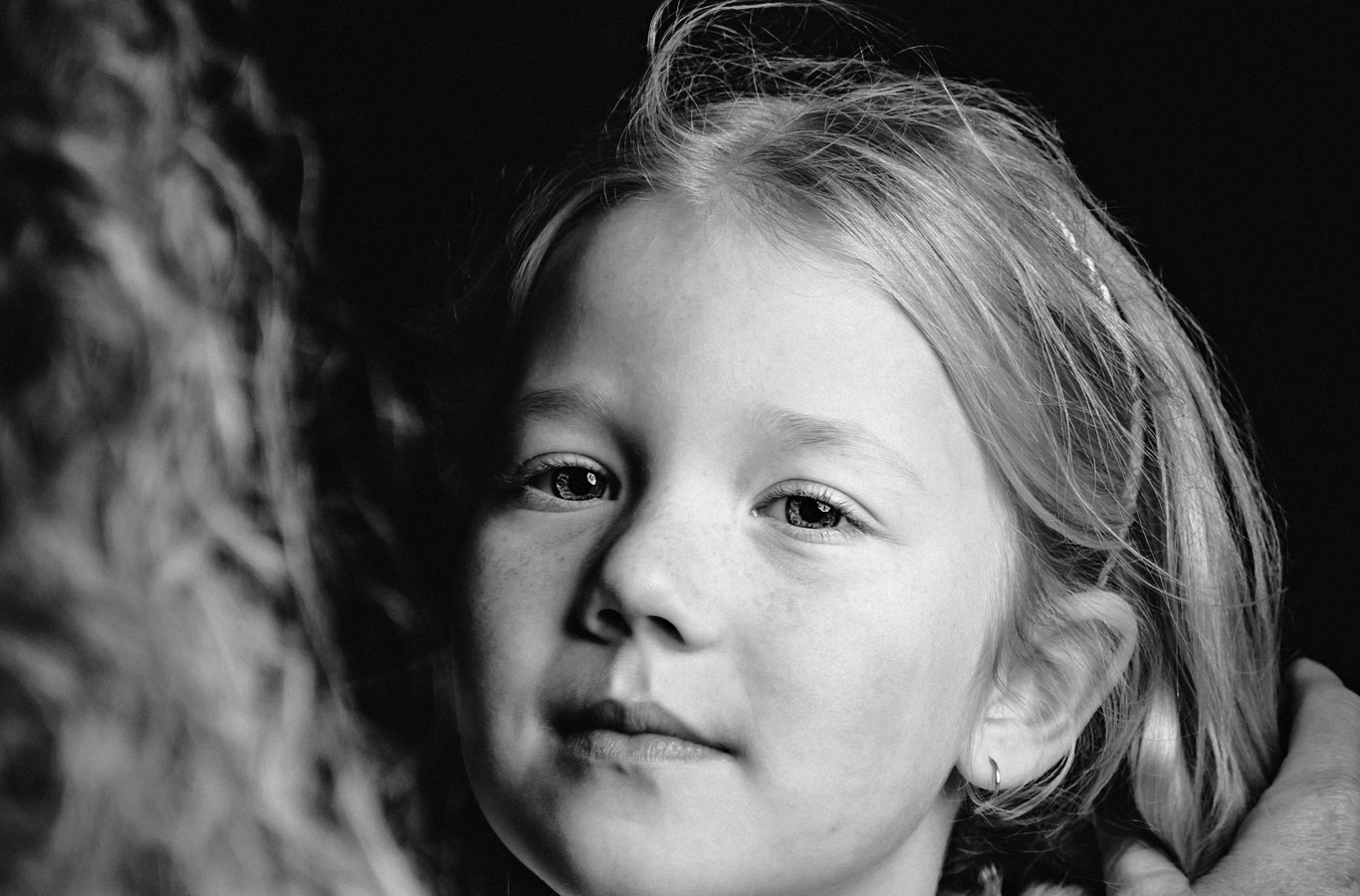
Phone photos capture what happened. A professional portrait captures who you are to each other. Your phone is brilliant at recording an event as it passes, but a portrait session is built to show your family's relationships and put you in the frame instead of behind the lens.
Your phone is built for moments, not relationships
Think about the last hundred photos on your phone. Most of them are documentation, a plate of food, a screenshot, a child mid-tantrum you'll laugh about later, a dozen near-identical shots of the same candle being blown out. They're useful. They're also, almost without exception, taken in a hurry, by whoever happened to have their phone out, aimed at whatever was happening in front of them at that second.
That's not a criticism of the phone. It's just what the phone is for. It's a recording device, always in your pocket, ready the instant something's worth remembering. What it isn't built for is slowing down long enough to see how two people actually stand next to each other, or how a child leans into a parent when they think no one's watching. Those things take time and attention that a quick phone photo, by its nature, doesn't allow for.
There's also the sorting problem. Somewhere on your phone, or backed up to a cloud account you rarely open, are thousands of images from the last few years. A handful are genuinely good. The rest are duplicates, blurry attempts, or half a dozen takes of the same pose because someone blinked. Nobody sits down and works through that archive looking for the ones worth printing, so the good ones stay buried with the rest, and none of them end up on a wall where you'd actually see them each day.
The person you're missing from almost every phone photo
Here's the part most families don't notice until it's pointed out. Go back through your camera roll and count how many photos you're actually in. If you're the one usually holding the phone, the answer is probably not many. You're the one behind the lens at the birthday party, the beach, the first day of school. Your children have thousands of images of everyone but you.
A portrait session flips that. You're not the photographer for the hour, you're a parent, present with your children, being watched and directed by someone whose only job is to notice the two of you together. That's the real difference between a phone photo and a portrait, and it has nothing to do with megapixels. It's the difference between documenting an event and being fully present in a relationship someone else is capturing. We talk more about what actually makes an image meaningful in what makes a portrait meaningful, but the short version is this: meaning comes from presence, not resolution.
Direction changes what a camera sees
At a session, Arek directs rather than poses. That distinction matters more than it sounds. Posing tells people where to put their hands and how to angle their chin. Directing means giving a family something real to do together, walk, talk, hold each other, and then watching closely for the moment their attention drifts back to each other rather than the camera. That's when a portrait stops looking like a photo and starts looking like your family.
It's also why timing is planned around your children rather than convenience. Sessions are set around sunrise or sunset, and around your children's age and routine, because the light and the mood both matter, and a tired toddler at midday won't give you the same family you get at golden hour when everyone's rested and the light is doing half the work for you.
What you actually walk away with
A phone photo lives in a camera roll, scrolled past, occasionally airdropped, rarely printed. A portrait session ends somewhere different. After the session, you come back within a week for a viewing and design appointment, where you choose your favourites and design the finished artwork together, rather than being handed a folder of files to sort through alone. The pieces themselves, canvas, framed prints, an album, are artisan printed and hand-finished, ready for you to collect within three weeks. There's no unopened download sitting on a hard drive.
A photo you took is a memory of a moment. A portrait someone else made of your family is a record of who you are, made while you were fully in it.
That's really the whole difference. For a lot of parents, a portrait session is the first time in years they've had a proper image of themselves with their children, rather than one more photo of the children alone. If that's the gap you've noticed in your own camera roll, it's worth reading how to choose a family photographer next, since the person behind the camera is exactly what makes the difference described here possible.
Prices are shown openly at the one-hour consultation at the Belgrave gallery, where you'll also see finished artwork in person and plan the session itself. Most families invest between $1,500 and $3,000 across the three appointments, with payment plans available. If you're already thinking about what everyone might wear, the free family styling guide is worth a look before you book, and the product guide will give you a sense of what the finished pieces look like once they're off the wall and in your home.
The gap doesn't close on its own
None of this makes your phone less useful. Keep taking the everyday photos, the ones that show what a random Tuesday actually looked like. But those images were never meant to carry the weight of showing your family as it is right now, together, at this age, in this season. That's a different kind of image, made differently, and it doesn't happen by accident on a phone held by whoever's closest. It happens when someone whose only task that hour is watching your family steps in, and you get to step, for once, back into the picture.
Every portrait begins with a conversation at the Belgrave gallery.