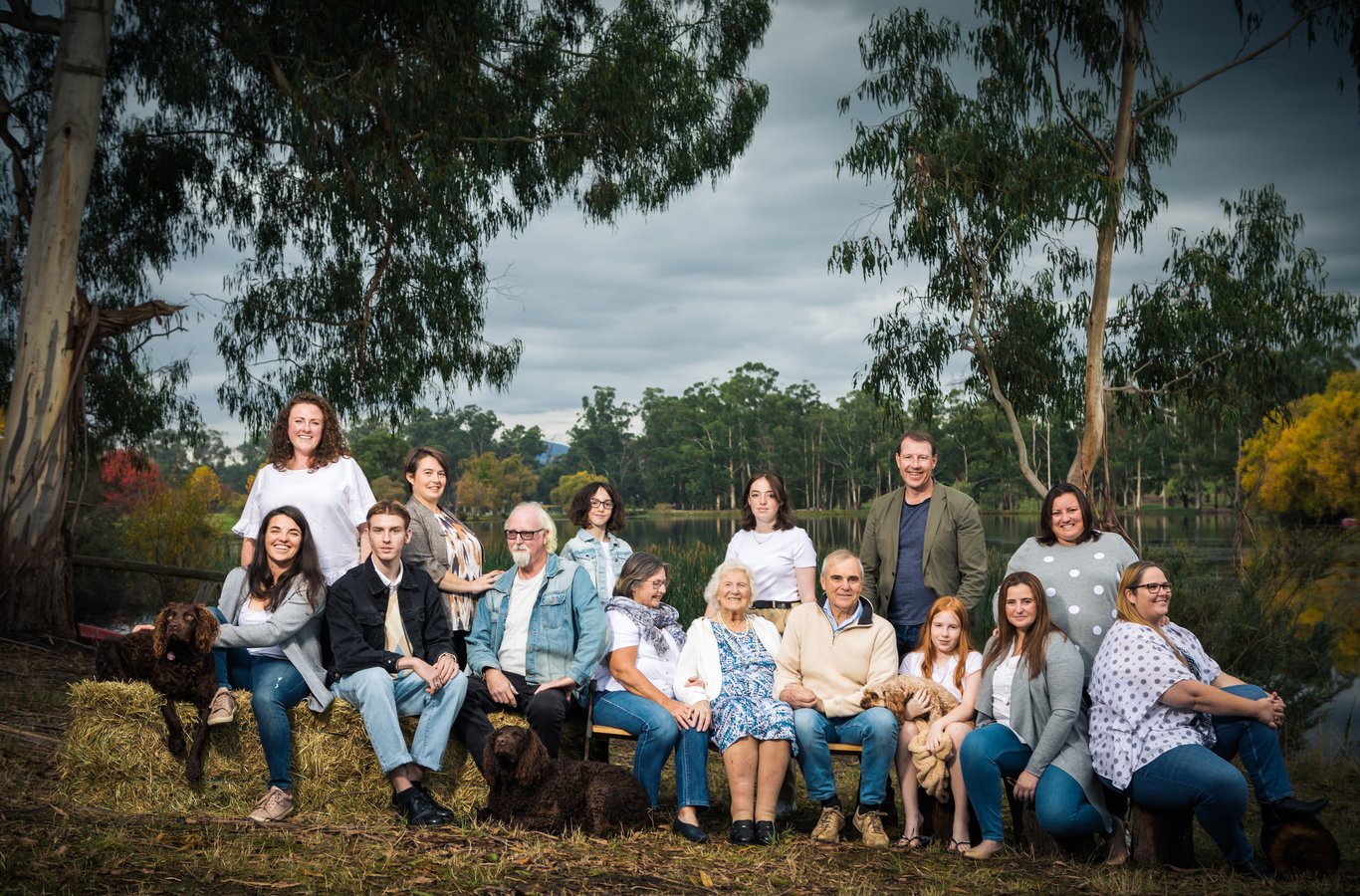
Planning an extended family portrait means solving for the same day, the same light, and a room full of different needs, grandparents, parents, children, sometimes an in-law or two. The way through it is to appoint one organiser early, agree groupings before the day rather than on it, and choose a time that suits the oldest and youngest people in the group rather than everyone else's preference. Get those three things settled and the rest, outfits, location, who stands where, falls into place at the consultation.
Start with one organiser
Every extended family session that comes together smoothly has one person driving it. Usually it's whoever had the idea in the first place, a daughter wanting a portrait with her parents, a mother wanting three generations in one frame before a grandchild starts school. That person doesn't need to make every decision alone, but they do need to be the one confirming the date, chasing replies, and fielding the inevitable "can we move it a week" text. Without a single point of contact, extended family sessions drift. Everyone assumes someone else is coordinating, and the date that seemed easy in the group chat quietly disappears.
If the portrait is a gift, for a milestone birthday or a first Christmas as a grandparent, the organiser is often not in the portrait at all. That's fine. The consultation is where they represent the family's wishes, and grandparents and siblings can be brought in on outfit and timing decisions without needing to sit through the planning themselves. If this is specifically about honouring grandparents, our guide to grandparent-focused portraits goes further into that particular case.
Choose a time that works for the oldest and youngest
A young family can work around most times of day. Add grandparents and the calculus changes, energy, mobility, and how long anyone wants to stand around in the cold or heat all come into it. Sessions here are timed around sunrise or sunset for the quality of light, and around a young child's routine so a nap or a meltdown doesn't derail the hour. With an extended group, that same principle just gets applied twice: the light dictates roughly when, and the oldest and youngest members of the family dictate how the hour is paced within that window.
It's worth naming this directly when booking rather than assuming it'll sort itself out. If a grandparent tires after twenty minutes standing, or a toddler is only reliably cheerful in the first part of the morning, that's useful information well before the session, not something to discover on the day.
Decide the groupings before you arrive
The biggest single time-saver for a large family session is knowing, before anyone shows up, what combinations of people you actually want portraits of. Grandparents with all their grandchildren. Each set of parents with their own children. The whole group together. Siblings on their own. It sounds obvious written down, but families often arrive having only pictured the big group shot, then realise partway through that they also wanted the grandparents alone with the newest grandchild, and now everyone's patience is thinner than it was an hour ago.
This is exactly what the consultation at the Belgrave gallery is for. It's a one-hour meeting before the session where you see the artwork, see the prices, and plan the session properly, including the shot list and groupings, so nothing gets worked out for the first time on the day. Arek directs sessions rather than posing them, so once the groupings are agreed the actual portraits stay natural and candid rather than stiff. Deciding the combinations in advance protects everyone's energy for the parts that matter, genuine interaction rather than logistics.
The families who enjoy their session most are the ones who've already agreed, before they arrive, exactly who's standing with whom.
Coordinate outfits without over-coordinating them
Extended family groups don't need to match, but they do benefit from a shared palette so nobody clashes or disappears into the background. This gets easier with more people involved, not harder, because a loose colour direction (say, warm neutrals, or navy and cream) gives everyone room to wear what suits them while still looking like one family in the finished piece. Our family portrait styling guide covers this in more detail and is worth sharing with the whole group rather than just the immediate family, since it's usually the in-laws and grandparents who ask last minute what to wear.
Where the session happens
Extended family sessions work at the studio or on location, and the choice often comes down to what the group can manage rather than pure preference. A location session in the Dandenong Ranges gives a natural, unhurried backdrop, but it also means more walking and less shelter if weather turns, worth weighing if mobility is a factor for anyone in the group. If you're still deciding between the studio and an outdoor setting, the guide on choosing a location in the Dandenong Ranges sets out what each option suits.
After the session
Within a week of the session, there's a viewing and design appointment where the family chooses favourites and designs the finished artwork together. With an extended family session this appointment often matters as much as the shoot itself, because it's where you decide which groupings become which pieces, a large collection for the family home, individual prints for grandparents to take with them, or a keepsake album that includes everyone. Most families invest between $1,500 and $3,000 across a session like this, with payment plans available, and prices are shown openly at the consultation rather than being a mystery you discover at the end.
Every portrait begins with a conversation at the Belgrave gallery.