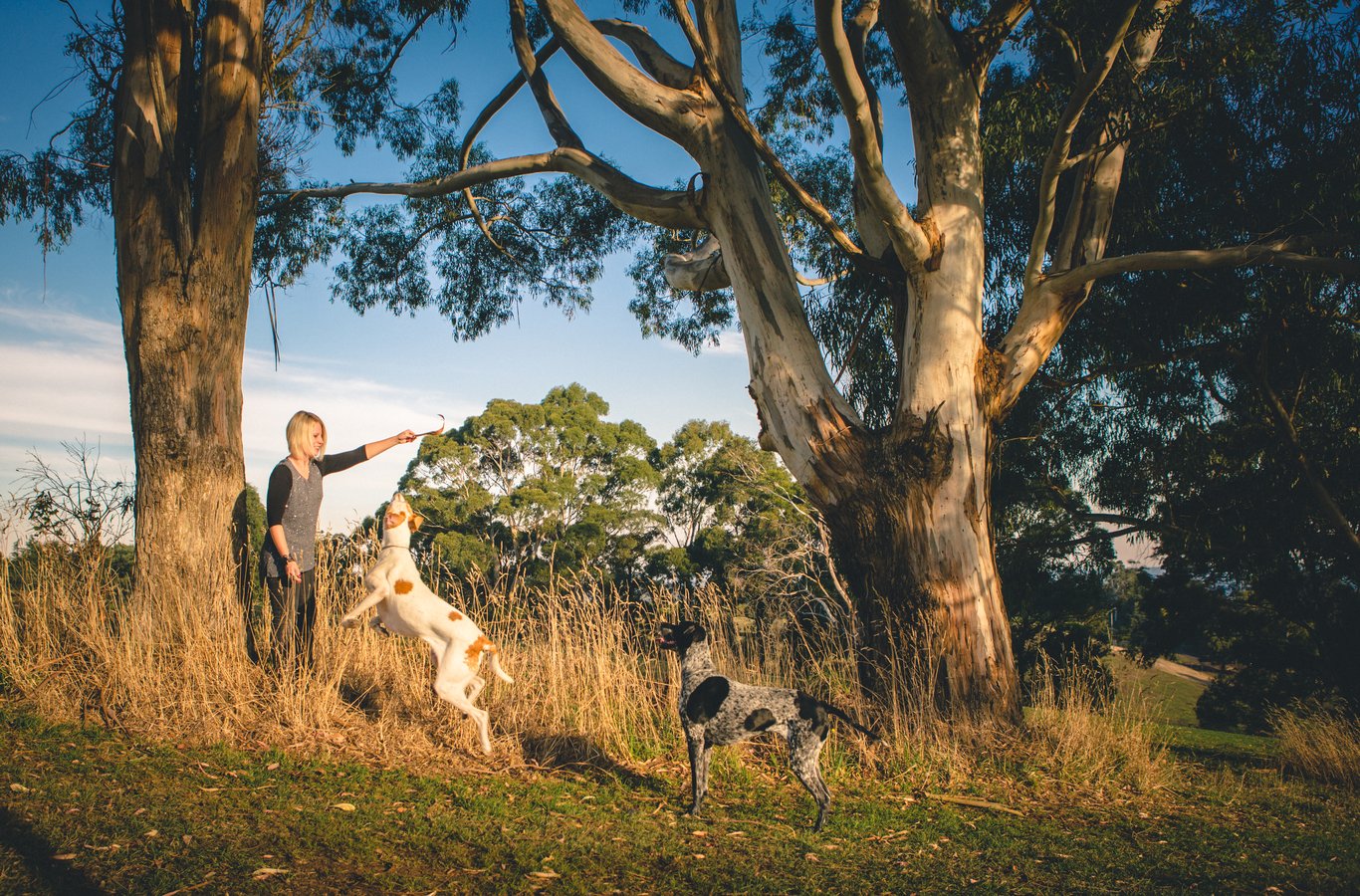
Golden hour photography in the Dandenong Ranges works because of what elevation and forest do to the light at either end of the day, not because sunset itself is pretty. Up in the hills, the sun sits lower against the tree line for longer than it does on flatter ground, and the edges of forest scatter and soften that low light before it ever reaches a family standing in a clearing or a paddock. That's why every session Arek runs is timed around sunrise or sunset, never dropped into the middle of the day.
What actually changes at that elevation
Belgrave and the surrounding Ranges sit high enough that the sun's path behaves differently to the same hour in the suburbs below. The light travels through more atmosphere at a lower angle, which is what gives it that warm, gold cast rather than the flat white of midday sun. Combine that with the elevation and the tree cover that lines every paddock and clearing up here, and you get a quality of light that's harder to find on open, flat ground elsewhere.
The forest edge does half the work
A stand of mountain ash or the tree line around an open paddock doesn't just provide shade. At the edges, where trunks and leaves are thin enough to let light through but dense enough to break it up, the sun gets filtered rather than blocked. That filtered edge light is soft in a way that a plain open sky can't match, and it's a big part of why a session in the Ranges reads differently to one shot in a suburban backyard. The forest portrait guide goes further into how that filtering works inside Sherbrooke Forest specifically, where the canopy is thickest.
Long shadows are the other half
In an open paddock, golden hour does something a clearing in the trees can't. The sun sits so low that shadows stretch long across the grass, giving a family portrait depth and shape in the ground itself, not just in the faces. A group standing in a paddock forty minutes before sunset throws shadows that lead the eye back into the frame, something that's simply absent from the same paddock at noon, when shadows pool flat underfoot instead of stretching anywhere. It's a small detail, but it's the difference between a portrait that looks staged and one that looks like a moment in a real evening. The locations guide covers how forest, garden and paddock settings each take this light differently, if you're still deciding where in the Ranges suits your family.
Why the timing is built around the light, not the clock
Golden hour isn't a fixed hour on a clock. It moves with the season, later in summer, earlier in winter, and the exact window on any given day depends on where the sun sits relative to the tree line at that time of year. That means a session booked for December and one booked for June are timed quite differently, even though both are chasing the same quality of light. Arek works this out at the consultation once he knows roughly when you'd like to shoot, then narrows the actual time closer to the date.
Working the light around your family, not just the sun
None of this matters if the timing doesn't also suit the people in front of the camera. A toddler who's overtired an hour before their normal bedtime isn't going to give you the relaxed, natural moments the light is there to catch, so the session time gets built around your children's routine as much as the sun's position. Sometimes that means starting a little earlier in the golden hour window to catch younger children before they tire, and sometimes it means pushing later if older kids and teenagers are more comfortable with a later start. The sunrise or sunset guide goes into how that choice between the two ends of the day gets made for your family specifically.
What this means for a paddock versus a forest session
If you already know you're drawn to the open, wide feel of a paddock, expect the long-shadow effect to be a bigger part of the finished portrait than it would be in a forest clearing, where the canopy is doing more of the softening and there's less open ground for a shadow to stretch across. Neither is better. It comes down to what kind of piece you want on the wall, one with depth built from shadow and grass, or one with depth built from filtered green light and texture. Arek talks through this at the consultation once he's seen how you respond to the sample artwork on display and understands what's actually going on your wall.
Overcast days aren't a lost cause
A cloudy sky at sunrise or sunset still carries the same low sun angle behind it, so the light comes through softer and more even rather than disappearing altogether. It's a different look to a clear golden hour evening, gentler, less warm in colour, but it's still built around the same principle of low, filtered light rather than the harsh overhead sun of midday. Genuine weather that won't work at all, heavy rain or unworkable wind, is the exception the session plan allows for with a change of location or a rescheduled date.
Bringing it together at the consultation
The reason golden hour gets this much thought before a single portrait is taken comes down to what's actually different about photographing in the Dandenong Ranges rather than anywhere flatter and lower. Elevation changes the sun's angle, the forest edges filter and soften it, and the open paddocks let it throw shadows that give a portrait real depth. All three of those things are working together only in that narrow window either side of sunrise or sunset, which is exactly why the session time is never an afterthought. It's set deliberately, around the season, the location, and your family's own rhythm, well before the day itself arrives.
Every portrait begins with a conversation at the Belgrave gallery.